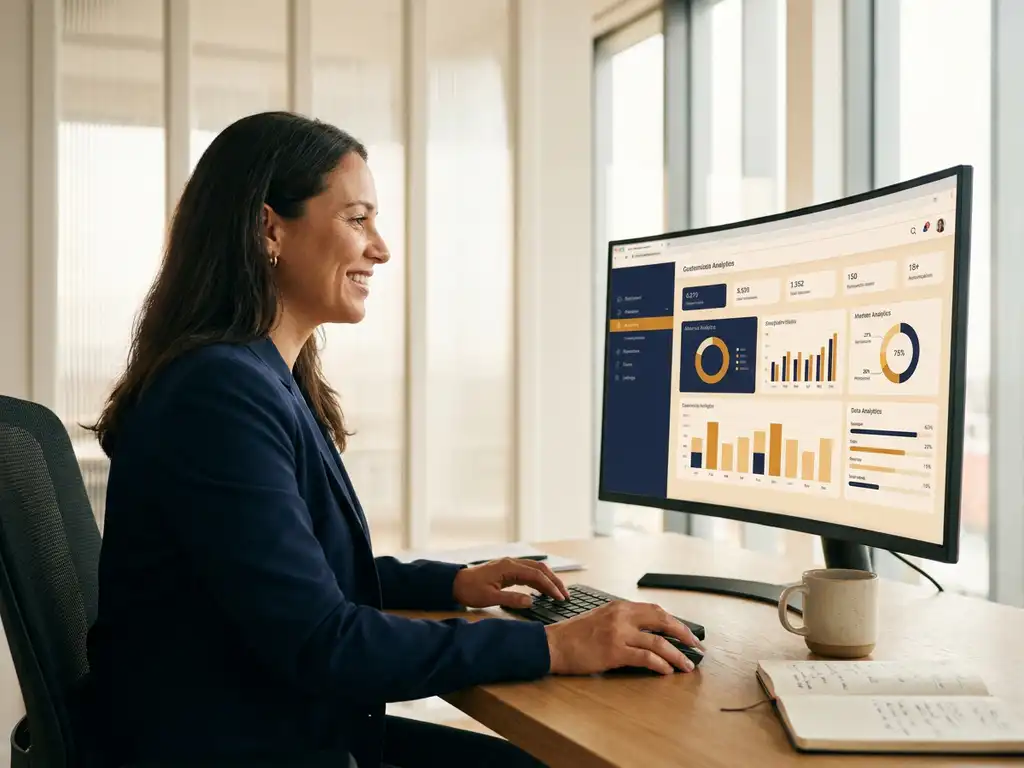
Managers gain real-time insight into their team results by linking employee feedback directly to a personal team dashboard that is automatically updated as soon as new data comes in. This means they no longer have to wait for an annual report, but can immediately see what is happening in their team and act on it. In this article, we answer the most frequently asked questions about team dashboards, continuous listening, and the practical prerequisites for working real-time insight.
What data do managers need to be able to act on it?
Managers don't need an exhaustive data dump, but targeted information on three levels: how engaged is my team right now, what are the main drivers behind that score, and which concrete signals require action? A dashboard that only shows an average score misses the point. A score tells you that something is going on; a story tells you what, why, and what you need to do.
Concretely, this involves the following data types:
- An overall engagement score such as the Energy Pulse Score or eNPS, as a quick thermometer for team sentiment.
- Drivers of that score, so it is clear which factors positively or negatively influence the experience. Think of workload, collaboration, development, or leadership.
- Open answers and explanations, because it is precisely the stories behind the scores that provide context that a number cannot.
- Trends over time, so a manager can see whether a dip is a one-off or structural.
- Signals that require follow-up, preferably via a structured system for closed-loop follow-up. That means: receiving feedback, setting an action, reporting back to the team.
The difference between data that paralyzes managers and data that sets them in motion lies in the selection and interpretation. Less is more, provided the right information is available at the right time.
How does a team dashboard differ from an organization-wide report?
A team dashboard shows only the results of one specific team, filtered by the manager who logs in. An organization-wide report aggregates all data and is intended for HR or management. The difference is not only in scope, but also in purpose: organization-wide reports are strategic, team dashboards are operational.
An HR director wants to know how average engagement is developing across departments, and where the biggest risks of absenteeism or turnover lie. A team leader wants to know whether his specific team is getting back on track after the reorganization, and which conversation he needs to have next week.
Good team dashboards have a number of characteristics that organization-wide reports do not always have:
- Role-based access. Every manager sees only their own team, not that of a colleague. This protects the privacy of employees and prevents mutual comparisons that have a demotivating effect.
- Anonymity thresholds. When a team is too small to trace individual answers, results are not shown. This is a hard prerequisite for trust and honest feedback.
- Action-oriented display. Instead of dozens of charts, a good team dashboard shows a priority list: this needs attention now, this is going well.
- Link to follow-up. A team dashboard without the ability to directly schedule an action or conversation is a report that stays at reading rather than doing.
How do you ensure that managers actually use their team data?
Managers only use team data structurally when three conditions are met: the data is understandable without statistical knowledge, the interface requires little time, and there is a clear expectation from the organization that something is done with it. Technology alone does not change behavior; it is about the combination of a good platform, clear agreements, and support.
What works in practice is the following. As an HR department, establish a rhythm in which team results are automatically shared with the relevant manager, preferably with a brief interpretation included. Not a twenty-page PDF, but a summary of three points that deserve attention. Link this to a team meeting, so the manager not only reads but also engages in conversation with their people.
It also helps to show managers what difference it makes when they do act. At CTAC, an IT service provider that works with continuous employee feedback, team leaders saw that naming and following up on one concrete improvement point already led to a noticeable shift in team atmosphere. That visible link between action and result is the strongest motivator for consistent use.
What is the difference between real-time feedback and an annual employee survey?
Real-time feedback is a continuous stream of short, targeted questions that employees receive at fixed moments or at specific events. An annual employee survey is a comprehensive measurement that takes place once a year. The difference lies in frequency, depth, and usability of the outcomes.
An annual employee survey provides a reliable overall picture, but has a fundamental drawback: by the time the results are available, the situation has already changed. An employee who indicates in February that their workload is too high no longer benefits in October from an action plan that is only drawn up then.
Real-time feedback via a pulse approach solves this by measuring briefly and frequently. Think of one or two targeted questions per month, automatically sent via a trigger based on a moment in the employee journey, such as after onboarding, after a reorganization, or at the start of a new quarter. The outcomes are immediately available in the team dashboard of the manager.
The two approaches are not mutually exclusive. An annual employee survey offers depth and benchmark comparison; real-time pulses offer timeliness and speed of action. The combination gives both HR and managers the complete picture.
What technical requirements does a real-time team dashboard impose?
A real-time team dashboard requires at least four technical building blocks: a measurement platform that processes data directly without a manual export step, role-based access rights, automatic anonymity thresholds, and a link to the HR system for current team structures. Without that link, the team structure in the dashboard is incorrect as soon as someone switches teams.
In addition, there are two requirements that are regularly underestimated in practice:
Integration with existing workflows. A dashboard that requires managers to log in to a separate system they otherwise do not use, will not be used. Real-time insight only works if it connects to the tools managers already use daily, or if the dashboard proactively sends notifications when something relevant occurs.
GDPR compliance and security. Employee feedback contains sensitive personal data. The platform must be GDPR-proof and ideally comply with ISO 27001, the international standard for information security. This is not only a legal requirement, but also a prerequisite for employees' trust that their answers are processed safely and anonymously.
When is real-time insight per team not a good idea?
Real-time team dashboards are not always the right choice. In three situations, restraint is appropriate: when teams are too small to guarantee anonymity, when the organizational culture is not yet ready for transparent feedback, and when there is no follow-up structure to act on the results.
A team of four employees cannot give anonymous feedback if five questions are asked and the manager can trace the answers. In that case, it is better to merge teams for reporting, or to report only at department level until the team is larger.
Furthermore, real-time insight only has value if there is someone who picks up the data. If an organization does not yet have a culture of follow-up and conversation, then a dashboard full of signals creates frustration rather than improvement. Employees notice when their feedback leads nowhere. That undermines the willingness to answer honestly the next time.
The rule of thumb: only start with real-time insight when the foundation is in order. That means clear responsibilities, a minimum team size of five to six employees for anonymous reporting, and an agreed rhythm for follow-up.
How CYS Group helps with real-time team insight for managers
CYS Group offers via the platform cx.management a complete approach for real-time team reports that managers actually use. The approach is based on twenty years of experience in employee experience and is specifically designed for organizations that want to move from an annual employee survey to continuous listening with follow-up per team.
What CYS Group concretely delivers:
- Custom team dashboards, with role-based access so that every manager only sees their own team data.
- The 3-question methodology and the driver model, with which you understand without statistical knowledge which factors determine engagement in a team.
- Automatic triggers via Datagarden, so that feedback is collected at the right moment in the employee journey.
- Closed-loop follow-up, including the Priority Matrix that helps managers prioritize which signals deserve attention first.
- GDPR-proof and ISO 27001-certified, so that employee feedback is processed safely and anonymously.
Do you want to know what real-time team dashboards look like for your organization and how you can get managers started immediately with their team results? Contact CYS Group and discover what is possible for your situation.
Make every experience count.
Frequently Asked Questions
Hoe vaak moeten managers hun teamdashboard raadplegen voor optimaal gebruik?
Een goede vuistregel is om het teamdashboard minimaal één keer per twee weken actief te bekijken, bij voorkeur gekoppeld aan een vast teamoverleg. Stel notificaties in zodat je automatisch een seintje krijgt wanneer er nieuwe data beschikbaar is of wanneer een score significant verandert. Het gaat niet om dagelijks controleren, maar om een consistent ritme waarbij inzicht direct leidt tot gesprek of actie.
Wat doe je als je teamdashboard een lage betrokkenheidsscore toont, maar je niet weet waar je moet beginnen?
Begin niet met de score zelf, maar met de drijvers eronder. Kijk welke thema's — zoals werkdruk, samenwerking of ontwikkeling — de grootste negatieve impact hebben en kies één concreet verbeterpunt om als eerste op te pakken. Bespreek dit openlijk met je team: laat zien dat je de feedback hebt gezien, wat je eraan gaat doen, en vraag om input. Die transparantie is al een eerste stap in de goede richting, nog vóórdat er iets structureel verandert.
Hoe ga je als manager om met negatieve of kritische feedback in je teamdashboard?
Zie kritische feedback niet als een aanval, maar als bruikbare informatie die je team je gratis geeft. Reageer niet defensief, maar erken de signalen in een teamgesprek — zonder te proberen individuele antwoorden te achterhalen. Medewerkers kijken niet alleen of hun feedback klopt, maar ook of er iets mee gebeurt; een open reactie en een concreet opvolgpunt versterkt het vertrouwen en verhoogt de bereidheid om de volgende keer weer eerlijk te antwoorden.
Kunnen medewerkers zien wat hun manager met hun feedback doet?
Dat hangt af van hoe de closed-loop opvolging is ingericht, maar in een goed systeem is die terugkoppeling expliciet georganiseerd. Dit kan via een teambespreking, een korte update in een teamkanaal, of een samenvatting van acties die zijn uitgezet naar aanleiding van de laatste meting. Die zichtbare koppeling tussen feedback en actie is cruciaal: medewerkers die merken dat hun input iets verandert, blijven investeren in het geven van eerlijke antwoorden.
Wat is de minimale teamgrootte voor betrouwbare en anonieme teamdashboardresultaten?
De gangbare ondergrens voor anonieme rapportage ligt bij vijf tot zes medewerkers. Onder die grens is de kans te groot dat een leidinggevende individuele antwoorden kan herleiden, wat de psychologische veiligheid ondermijnt en de kwaliteit van de feedback verlaagt. Bij kleinere teams kun je beter rapporteren op afdelingsniveau of teams samenvoegen totdat de groep groot genoeg is voor veilige, anonieme inzichten.
Hoe overtuig je sceptische managers die weinig vertrouwen hebben in medewerkersonderzoek?
De sterkste overtuiging komt niet uit theorie, maar uit een concreet voorbeeld dichtbij huis: laat zien wat er veranderde in een team dat wél actief met de data aan de slag ging. Scepticisme verdwijnt sneller als een manager ziet dat een collega na één gerichte aanpassing in werkdruk of communicatie een merkbare verbetering zag in de teamsfeer. Bied sceptici ook een lage drempel: begin met één meting, één dashboard, één gesprek — en evalueer daarna samen wat het heeft opgeleverd.
Hoe zorg je ervoor dat medewerkers serieus blijven deelnemen aan pulse-metingen en niet afhaken?
De belangrijkste factor voor blijvende deelname is zichtbare opvolging: medewerkers haken af als ze het gevoel hebben dat hun antwoorden in een zwart gat verdwijnen. Houd de vragenlijsten kort (één tot drie vragen per meting), varieer de vragen zodat het niet repetitief voelt, en communiceer na elke meting wat er met de uitkomsten is gedaan. Een hoge responsratio is geen technisch probleem, maar een cultuurvraagstuk — en het begint bij het vertrouwen dat eerlijke feedback welkom is en daadwerkelijk iets verandert.