

Best Practices in Customer Experience Management
KPMG annually investigates individual consumer experiences with brands worldwide. In its Customer Excellence research in 2024, the following companies in the Netherlands come out on top:
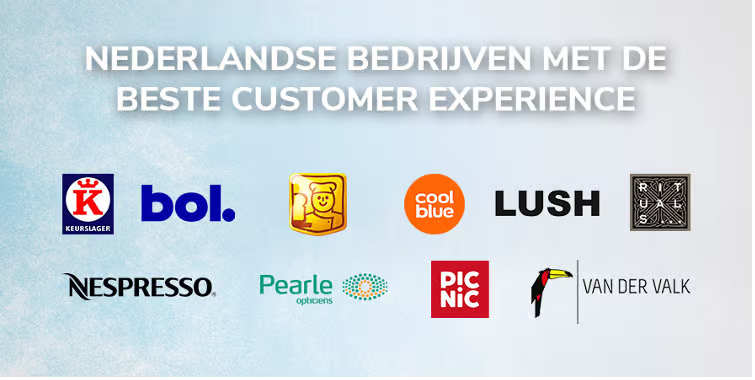
Dutch companies with the best Customer Experience
In its research, KPMG assesses organizations on 6 criteria:
- Personalization: using individual attention to create an emotional bond
- Empathy: gaining understanding of the customer’s circumstances to create a deep connection
- Expectations: managing, meeting, and exceeding customer expectations
- Time and effort: minimizing customer effort and creating frictionless processes
- Resolution: turning a poor experience into a great one
- Integrity: being trustworthy and instilling confidence
The European Customer Experience Awards platform in 2024 recognizes the following brands and organizations for their CX excellence:
- IKEA (best CX Strategy, employee-driven CX, and customer-centric culture)
- Volvo Car Group Customer Care (best use of customer insights and feedback)
- Radisson Hotels (best use of technology, customers at the heart of everything strategy)
- TUI (customers at the heart of everything, CX team of the year)
And in the Netherlands, Marketresponse annually asks consumers who they consider the most customer-friendly company in our country. According to this research, the 10 most customer-friendly companies in the Netherlands in 2024 are:
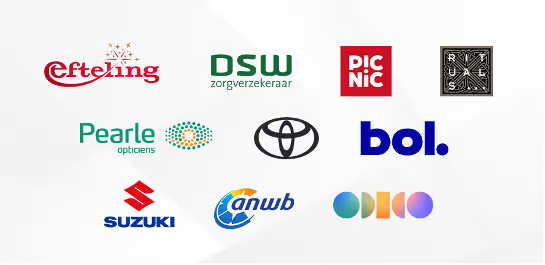
Once again in 2024, Efteling is in first place.
What are the Characteristics of a Customer-Centric Culture?
What we consistently see in organizations with a customer-centric culture, which have successfully managed customer feedback in their daily processes, is that the following elements are present:
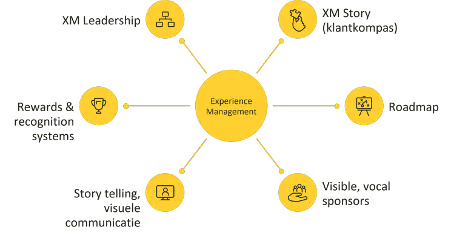
- Experience Management (XM) leadership is essential. CX transformations require leadership with long-term commitment. A CX leader must therefore be R.O. I borrowed this term from Nienke Bloem CCXP CSP, referring to a role as “Chief Reminder Officer”. This indicates that CX leadership is not temporary but requires continuous attention and repetition. The CX story must be constantly repeated, appearing in every presentation. By continuing to repeat, people begin to anticipate the message.
- Customer-centric organizations typically have a clear XM story that aligns with business goals, overall strategy, brand promise, and customer commitments. A customer compass, which defines the customer ambition (for example, becoming a market leader within 2-3 years) and the desired customer experience
- There is also a clear roadmap: we know how we will build this customer-centric culture over the next 1-3 years. Additionally, each team has determined in its operational plans how it will contribute to this desired experience.
- Organizations with a customer-centric culture typically have sponsors (at C-level) within the organization who ensure that the CX transformation remains important within the organization and continues to be promoted, both internally and externally. Support at C-level is crucial for any CX transformation.
- Making the XM Story, customer journeys, customer promises, personas, etc. visual also plays an important role. We see the customer compass and desired experiences being communicated on posters, videos, booklets, and other communication tools with their own branding, quotes, and visuals that reflect the message.
- Organizations with a customer-centric culture make it playful and fun. A fair competition or contest system is linked to it, a system of rewarding and complimenting all initiatives that contribute to a better customer experience or higher NPS.
What Do We Learn from Organizations with a Customer-Centric Culture?
As an example of an organization with a customer-centric culture, I’ll take De Efteling. An organization where 9+ thinking and doing is carried through in all details and where we find all these elements of a customer-centric culture. Efteling is and remains an inspiring example of how an organization can continuously strive to exceed customer expectations and thus strongly connects with its customers. 1 in 5 Dutch people visit Efteling every year, and during a lifetime, a person visits Efteling an average of 7 times.
Crooked Paths Philosophy
At Efteling, “enchantment and wonder” are important core values. The ideas of Anton Pieck are embedded in the DNA and culture of the organization. They call it the “Crooked Paths” philosophy. In the fairy tale park, there are no straight paths, but crooked roads. You can only see 50 meters ahead, and then there’s a bend, after which you’re surprised again by what you see.
This philosophy is also extended to the leadership style, where employees are encouraged based on their talent to create that wonder on the guest’s face at any moment. Whether you’re buying fries or standing in line for the Danse Macabre. At Efteling, it’s clearly the people who make the difference and who are given the freedom to create that 9+ experience.
Team leaders start the day with a short conversation with the entire team. To go through the planning and points of attention, but also to gauge if everyone is feeling good and to address that if necessary. Because a day at Efteling can be as fun as it gets, if a visitor doesn’t feel well-helped by an employee, it can immediately cast a shadow on the entire experience. Excellent service begins with employees who are enthusiastic. Therefore, when hiring, motivation and a customer-oriented attitude are considered more important than having a hospitality background.
Apps and other digital applications are used to make everything that’s unpleasant less unpleasant. Such as waiting for attractions. There are apps that tell you where the queues are shortest – thus ensuring a wider spread – and if you still have to wait somewhere, there’s an app with which you can play a game together.’
Guest Feedback as a Starting Point for Change
Efteling has (according to their own statement) an NPS of at least 70. If guests give an eight, they are actually not satisfied. Guests expect at least a nine from Efteling. Efteling sees it as its biggest challenge to meet these high expectations at all times.
How Efteling incorporates feedback from its guests into its improvement process can be seen, for example, with Danse Macabre.
Making the Experience of the Attraction less Intense
From the opening of this attraction, Efteling received a lot of positive feedback from visitors praising the visual and auditory elements and the special theming. Some critical feedback was about the intensity of the experience, which might not be suitable for everyone. Efteling immediately responded to these concerns by making various adjustments to make the experience more accessible for young families. In some cases, the sound and light intensity in parts of the queue were adjusted to make the experience less overwhelming for children. More information was also provided to parents at the entrance of the attraction, with clear information about the content level of the experience (for example, warnings about sensitive themes). Additionally, quieter spots were created in the waiting area where families with young children can take a break if the atmosphere becomes too intense.
Making Waiting Times more Pleasant
Some visitors indicated that the waiting times for Danse Macabre were relatively long, especially during peak hours, causing frustration and loss of patience. This often occurred during summer months or weekends when the park was busier, and guests indicated that the waiting time made them feel the experience was less enjoyable. Efteling acted by improving waiting time management, both by making the experience in the queue itself more attractive (as mentioned earlier, by adding thematic elements and interactive components to the waiting time), and by realizing faster inflow. For example, they used virtual waiting times and the app to allow visitors to stay informed about their waiting time near the attraction, so they could plan better and reduce waiting time by doing other things in the park. Additionally, extra attention was paid to aligning capacity and improving visitor flow, especially during busy periods, so that waiting time was less likely to be experienced as frustrating. More entertainment elements were also added, such as employees engaging with visitors during the waiting time, to make waiting less tedious.
Better Explaining the Theme
Some guests indicated that they found it difficult to follow the story and thematic elements of the attraction well, especially for people unfamiliar with the specific concept of Danse Macabre and its mythological elements. Efteling anticipated this by providing more contextual explanation in the waiting areas and at the entrance of the attraction. This was done through information boards, digital screens, and even the Efteling app, which offers visitors more background information about the characters, story, and theme of the dance of the dead before and during the waiting time. A better story structure was also created to make it easier for guests to understand what was happening, especially at the beginning and end of the ride.
Through these quick and customer-oriented adjustments, Efteling has once again proven that customer-oriented thinking is a high priority, and ensures that all visitors can experience a 9+ experience.
Conclusion
Efteling remains an interesting example of an organization that has fully integrated customer orientation into its culture and way of working. What we can learn from Efteling is that a CX transformation is a dynamic process that requires involvement from both employees and technology. It is essential to keep experimenting and innovating to meet the ever-changing expectations of customers.
In part 2 of this series on “CX Transformations – from measuring to improving”, we will discuss the steps to go from data and insight to action and share concrete tips about this.
🔎 Want to Know more?
Want to discover how we can help your organization with data-driven working (from measuring to improving)? Schedule a free consultation with us!