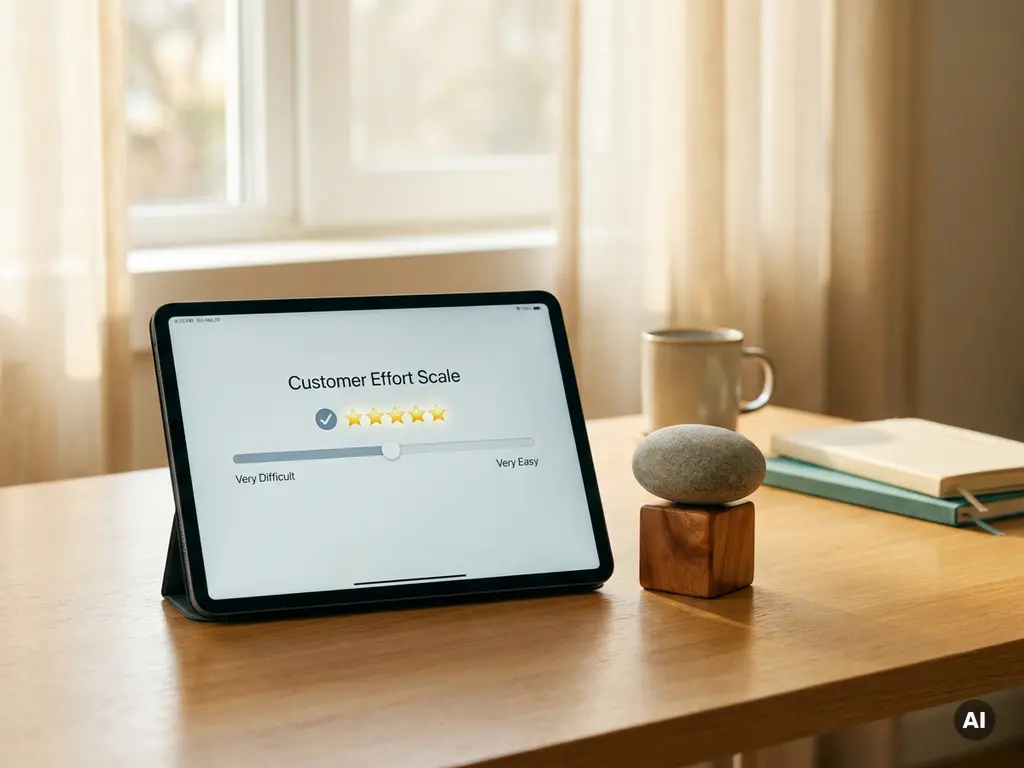
Now that you know more about using NPS (Net Promoter Score) when measuring the Voice of the Customer, let’s take a closer look at two other commonly used CX KPIs. These are CES (Customer Effort Score) and CSAT (Customer Satisfaction Score). Which KPI measures what and what does it deliver? We cover that in this blog!
CES (Customer Effort Score): how much effort does the customer have to put in?
What does CES mean? The Customer Effort Score is a customer-centric KPI that measures experience and amount of effort. After all, customers don’t want to go to too much trouble to make a purchase or get a question or problem solved. CES reflects the customer’s encountered effort and measures you with the demand:
‘How much effort did you have to make to get your question fully answered / to complete your purchase of product x?’
Respondents answered the CES question on a scale of 1 (very much difficulty) to 5 (very little difficulty). The calculation of CES, like the Net Promoter Score (NPS), works with an absolute score. To calculate the score, take the percentage of score 5 (very little difficulty) plus the percentage of score 4 (little difficulty). From this total score, the summed percentages of score 2 (much difficulty) and score 1 (very much difficulty) are subtracted. Thus, the final CES score can be between -100 and +100.
Convenience serves man. Making as little effort as possible is what makes customers happy. And you won’t really know what does or doesn’t bother clients until you ask them. Organisations often overlook a crucial point: convenience. Customers are not necessarily loyal because the service was excellent rather than normal. The ease with which customers received service has a much greater impact on loyalty.
CSAT (Customer Satisfaction Score): customer satisfaction
In addition to the NPS and CES score, the Customer Satisfaction Score is also a customer experience KPI. The CSAT reflects satisfaction. Unlike the other KPIs, this is not measured as an absolute score. CSAT is a number and can be compared to a score. The customer is asked to assign a rating in the form of a number on a scale of 1 to 10. You apply CSAT particularly when a recommendation question is not appropriate, such as in government or healthcare institutions.
Where NPS focuses on the long term such as customer loyalty, CSAT measures satisfaction in the short term after a certain touchpoint. It provides an answer to the question:
‘How satisfied are you with product x / the handling of your question x?’
What do CES and CSAT deliver?
The convenience score (CES) and the satisfaction score (CSAT) are part of valuable customer feedback (Voice of the Customer). For instance, the Customer Effort Score has a strong predictive value for future customer purchasing behavior, such as a repeat purchase or higher spending. The less effort, the greater the intention to remain a customer and the fewer negative statements about the organization in question.
For employees, a CES or CSAT is meaningful and easy to trace back to, for example, the Customer Journey or a timeline. At what point did it become less attractive for the customer and/or did more effort have to be made? This simplicity makes it immediately understandable for employees how they can contribute to a better score themselves, namely by making it easier for the customer. Research, analyze, and (sometimes literally) remove the barriers that hinder your customers.
After all, customers are the heart of the organization that you want to serve to their full satisfaction. And that is not the same as saying: ‘The customer is king!’. Take customer feedback seriously and listen to the story behind the score. At many organizations, measuring the Voice of the Customer stops with the focus on the number, while the feedback from the open and follow-up answers is precisely what is important. You find out what is going well in the organization and where there is room for improvement. Read about the importance of the Voice of the Customer for organizations in the next blog.
Using multiple customer-centric KPIs
In practice, we see that the use of Customer Experience KPIs is most successfully implemented when the use of a single KPI is chosen. Use the customer journey to determine what kind of question you want to ask at what moment. Think in advance about what you want to know and why. Direct everyone within the organization based on NPS, CES, or CSAT.
This does not change the fact that NPS, CES, and CSAT are connected to each other. By reducing customer effort and meeting expectations so that the customer is satisfied after the touchpoint, you increase customer loyalty. The easier it was for the customer to ‘do business’, the more satisfied the customer is (meeting expectations) and the greater the intention to recommend. Through customer-centric KPIs such as NPS, CES, and CSAT, customer feedback can substantially contribute to achieving organizational goals with ultimately more satisfied customers, more enthusiastic employees, and more revenue through the combination of the above two KPIs.