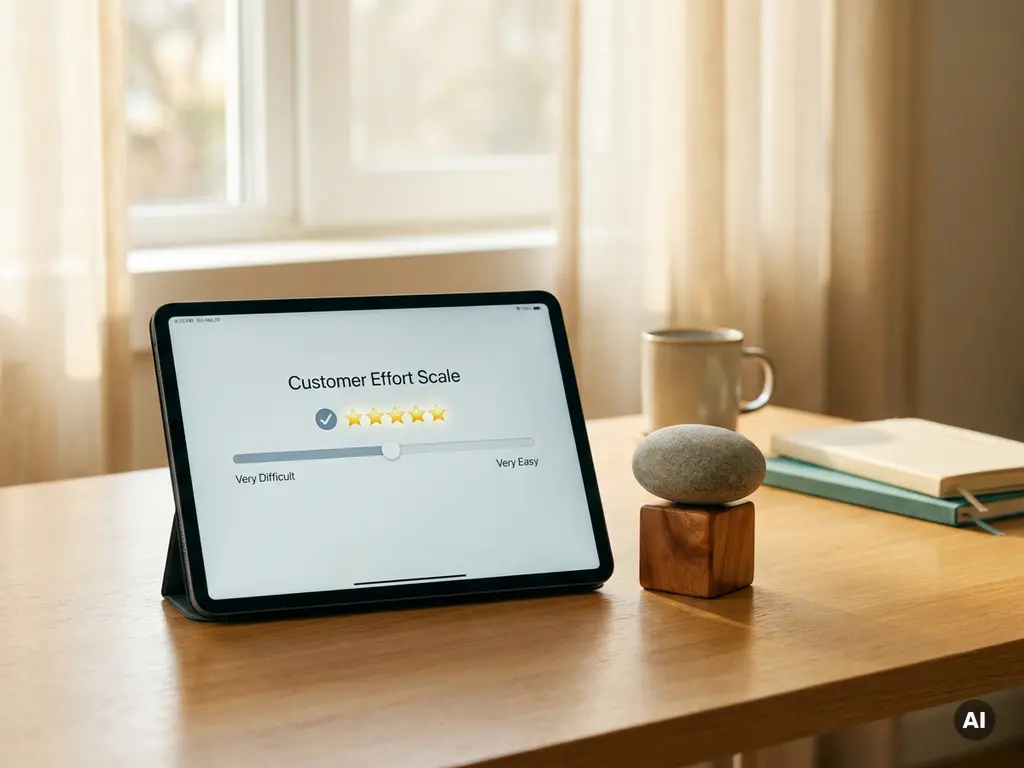
From “Transactional Data” to “Transformational Growth”
We essentially distinguish 4 phases in CX transformations to move from data to growth:
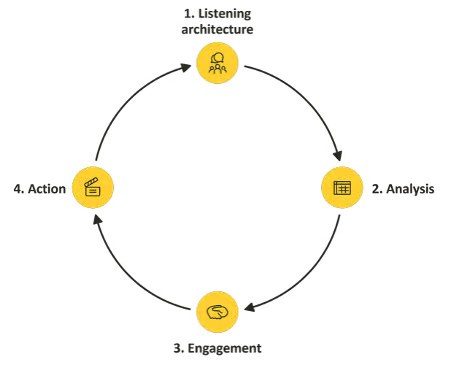
We see these 4 phases as a continuous process, because based on the actions taken (phase 4), we also learn which adjustments are needed to optimize the measurement framework (phase 1).
Phase 1: Listening Architecture
Data-driven work begins with setting up the measurement framework within which you will organize the Voice of the Customer (VOC) or Voice of the Employee (VOE). The CX transformation starts with collecting feedback, for example through surveys, social media, and direct interaction. Based on this feedback, you can identify pain points and opportunities for improvement. The use of Customer Journey Mapping can be useful here to map out the various touchpoints about which you want to collect feedback.
Short, focused questionnaires using the 3-question methodology, as we like to use at CYS, generate the best response and provide direct insights into the root causes or drivers behind your KPI, NPS, CSAT, or CES.
Based on the chosen metrics, formulate concrete goals for improving the customer experience. This could be, for example, a specific target score for the NPS or reducing the response time to customer inquiries by x%.
Phase 2: Analysis
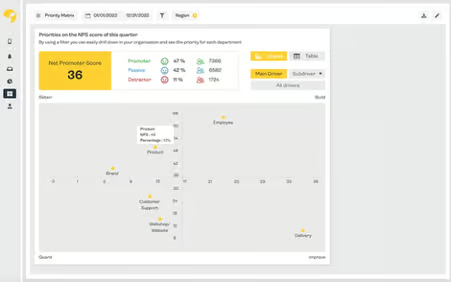
The analysis phase: once sufficient feedback has been collected, you can analyze which levers you need to adjust first to optimize the experience for your customers. By using smart, flexibly configurable dashboards, you can quickly get to the core of where the right follow-up actions can be taken. For example, a dashboard widget with a priority matrix clearly shows at a glance what the most important drivers are behind your NPS, for instance, and which drivers have the most important areas for improvement.
Phase 3: Engagement
In this third phase of data-driven work, it’s about sharing insights and getting the team excited to work with them. Employees are often the key to a successful CX transformation.
Phase 4: Action
In this fourth phase of data-driven work, it is then about experimenting and taking various actions to increase the impact on the customer experience.
We will go into phase 3 (engagement) and 4 (action) in more depth in the remainder of this article.
Engagement: how do you involve your employees in the CX transformation?
How do you proceed if you want to get your employees on board with data-driven work? It starts with defining and recording how we want customer feedback to have a structural place in daily processes and how we want employees to act on this feedback: the so-called ‘One Way of Working‘. With whom do we share which customer feedback and what do we expect people to do with this customer feedback?
Many CX transformations therefore start with ‘awareness sessions’ with colleagues who already have a positive vibe around CX data and are therefore most open to CX initiatives. Preferably start with cross-functional teams of CX ambassadors to increase awareness around CX and the impact they have on it themselves: what is customer experience, why is it important, what is the desired experience at our company?
Foodservice organization Albron, also a loyal CYS customer for many years, has done it this way, for example. CYS set up a process for them in which approximately 800 PowerPoint push reports are automatically sent weekly to all the different teams within the organization, who now have this as a standard item on the agenda of their weekly meetings. In these reports, we include an assignment to determine 3 improvements every month and to make a plan (based on a fixed template) of what they are going to do, what they need, and who they need.
Make it stick: use ‘tiny habits’
The challenge here, of course, is to keep it up. CX transformations are about a fundamental behavioral change to make the way of working around data-driven work a fixed routine.
In this context, I find it inspiring how Allianz Benelux uses ‘tiny habits’ to facilitate this behavioral change. Listen to the podcast ‘Tiny Habits at Allianz Benelux with Martijn Huisman‘.
In this podcast, @martijn-c-huisman explains how Allianz Benelux, with the help of CX transformation expert zannavanderaa.com, applied the technique of “tiny habits” to integrate CX thinking into the daily operational process.
Tiny Habits is a methodology described by BJ Fogg of Stanford University in his book of the same name. Applied to CX transformations, it essentially comes down to linking one or more tiny habits to a certain (NPS) driver that you want to influence. For example, if analysis shows that the root cause ’employee’ and within that ‘personal contact’ is an important driver for your NPS, you can create tiny habits that employees can choose from to give more personal attention to their customers.
Action: with which actions do you make a real impact?
The fourth phase in the CX transformation (after you have ‘engaged’ your employees on the impact they can make on the customer experience) is the Action phase. In fact, this is about closing the feedback loop. How do we act on the feedback we have received from our customers?
With closed-loop feedback, we distinguish between an Inner and an Outer loop.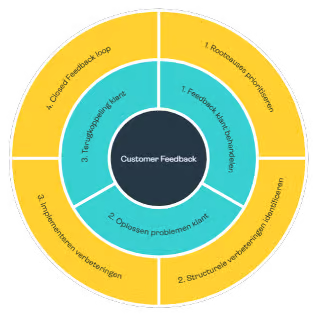
The Inner loop is about how we act on feedback from individual customers (1-on-1). In the event of a low score, for example, we immediately send a trigger to a manager who can take immediate action and, if possible, ensure that direct contact is sought with that customer: closed-loop feedback.
In the case of an extremely positive score, this can be a trigger to thank the customer for their feedback, ask them to post a review, and you can compliment the employee in question who spoke to the customer.
CYS offers an integrated ticketing solution in its platforms, called Case Management, which makes it possible to create tickets based on customer feedback, assign them to someone, and monitor how these tickets have been handled.
The Outer loop is about how you initiate more structural improvements based on your customer feedback analysis. So, if you see things based on customer feedback data that are structurally not going well or where there are important opportunities for improvement, then it is important to focus on those in the improvement process.
We see that these can be different types of actions, such as:
- Actions for improvements on root causes concerning employee behavior, to inspire them and make them more aware of how they themselves can make more impact on the customer experience.
- Actions for improvements on root causes that are more non-behavioral: for example, to evaluate whether the steps in the customer journey (or different channels) still sufficiently align with the customer ambitions or desired customer experience. This results, for example, in actions aimed at improving the user experience in certain digital channels.
- Actions aimed at designing (new) ‘wow moments’ for your customers, to create memorable customer experiences.
The Action phase is therefore essentially the phase within the CX Transformation where the ‘magic happens’. Because that is where experiments are conducted and initiatives are taken that result in an improved customer experience. Which we will then also see reflected in improved CX results in the new customer feedback measurements.
Conclusion
If you want to anchor data-driven work sustainably within your organization, 4 phases are required: listening architecture, analysis, engagement, action. Successful CX transformations require commitment from both employees and technological innovation. In data-driven work, it is essential to continue experimenting and innovating to meet ever-changing customer expectations.
🔎 Want to know more?
Do you want to discover how we can help your organization with data-driven work (from measuring to improving)? Request a free consultation!